Looking for Dealpath Alternatives?
Teams searching for Dealpath alternatives typically want one of two things: a deeper analysis layer that Dealpath doesn't provide, or a single platform that handles both deal management and AI underwriting. AcquiOS addresses both.
Unlike Dealpath - which is built around pipeline visibility and portfolio reporting - AcquiOS is built around the analysis that Dealpath lacks. Forward a broker OM and AcquiOS extracts every assumption, validates each against market data, flags structural conflicts, and populates your existing Excel template in minutes. No other Dealpath alternative delivers this combination.
Why This Comparison Matters
Both AcquiOS and Dealpath serve institutional real estate investors, but they solve fundamentally different problems. Dealpath excels at managing deal pipelines and reporting across a large portfolio: it's the operating system for your deal flow. AcquiOS focuses on the analysis layer, turning broker offering memorandums into investment-ready underwriting models in minutes, validating assumptions against market data, detecting structural conflicts, and outputting to your template.
Think of it this way: Dealpath is where deals live and get tracked. AcquiOS is where deals get deeply analyzed. They're complementary in many cases, but if you're choosing one, the decision comes down to your primary pain point. Are you drowning in deal volume and struggling to screen them quickly? Or are you managing deal flow fine but spending too much time on repetitive analysis work?
Quick Capability Comparison
| Capability | Dealpath | AcquiOS |
|---|---|---|
| Pipeline Management | ✓ | ✓ |
| CRM / Relationship Tracking | ✓ | ✓ |
| AI Underwriting (OM to Model) | ✗ | ✓ (90 sec) |
| Assumption Validation vs Market | ✗ | ✓ |
| Structural Conflict Detection | ✗ | ✓ |
| Rental Rate Verification | ✗ | ✓ |
| Due Diligence Project Management | ✗ | ✓ |
| Investment Memo & Deck Generation | ✗ | ✓ |
| Output to Your Templates | ✗ | ✓ |
| Email-to-Deal Creation | ✗ | ✓ |
| Portfolio Reporting & Insights | ✓ | ✓ |
| Broker Marketplace | ✓ (Dealpath Connect) | ✗ |
Detailed Feature Comparison
Deal Pipeline and Workflow
Dealpath's pipeline management is enterprise-grade. With 300+ institutional firms using the platform and $10T+ in transaction volume, their pipeline workflows are battle-tested. You can customize deal stages, track relationships, assign tasks, and generate reporting across your entire portfolio. If your primary workflow challenge is visibility into your deal funnel and portfolio health, Dealpath is built for this.
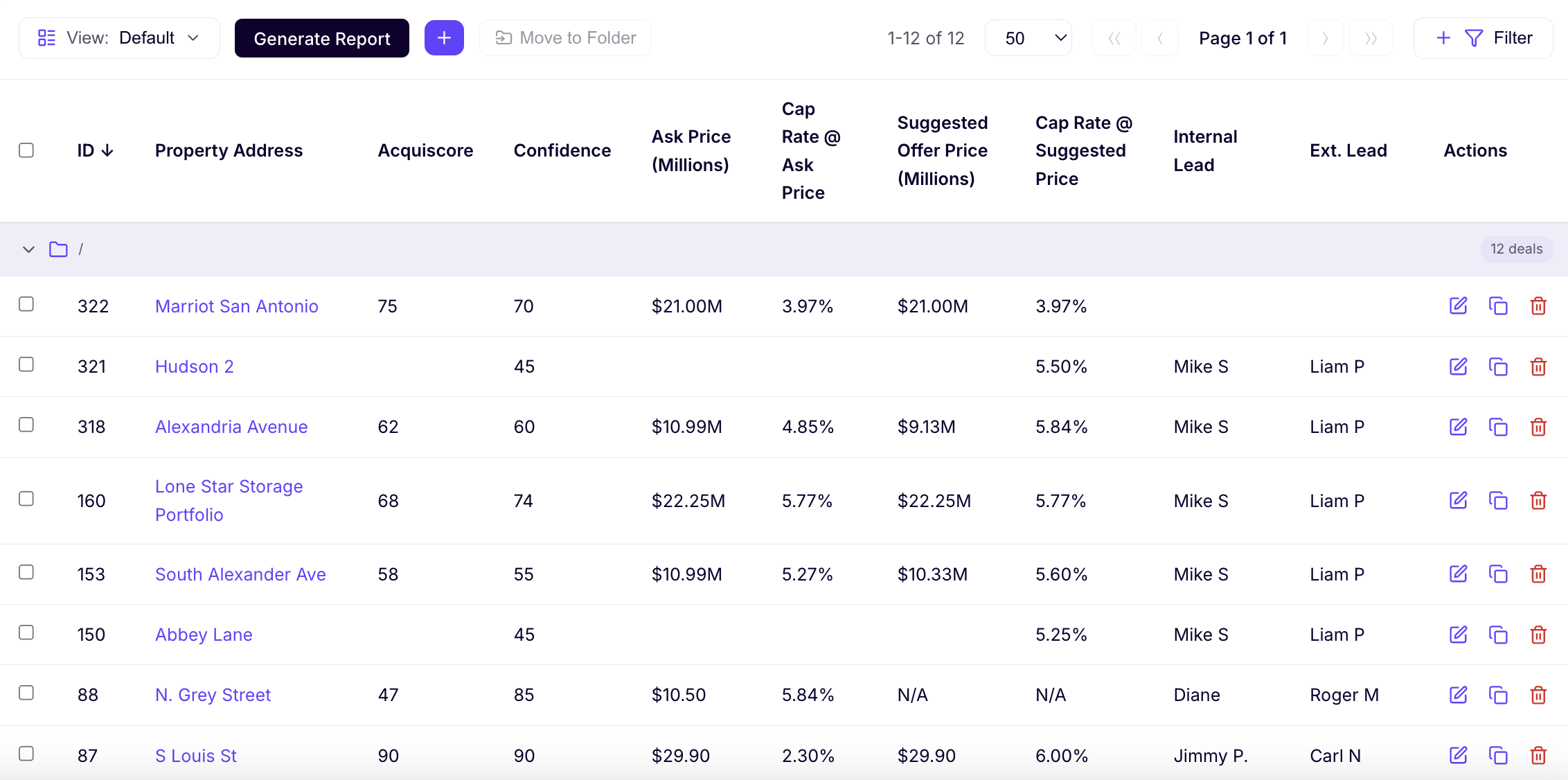
AcquiOS also has pipeline management, but we built it differently. Our focus is on making it effortless to feed deals into analysis. Email a broker OM to our platform and we auto-create the pipeline entry, extract the key assumptions, run validation, and flag conflicts. Pipeline management isn't our differentiator; speed of analysis is.
AI and Underwriting
This is where the two platforms diverge most sharply. Dealpath has introduced AI features focused on data extraction and deal intake. Their approach centers on getting deal data into the platform efficiently. AcquiOS goes further: we generate a complete underwriting model, validate assumptions against market data, and detect structural conflicts - not just extract data.
AcquiOS was built from the ground up for AI-powered underwriting. We take a broker OM and generate a complete Excel model in minutes: proforma, sensitivity analysis, valuation. Then we validate those assumptions against market data, detect internal inconsistencies (rent growth assumptions that don't match cap rate compression, debt service coverage ratios that are mathematically impossible), and surface rental comps from public databases. Every number is cited back to source.
Assumption Validation and Market Intelligence
Dealpath offers market tracking and portfolio insights but doesn't systematically validate underwriting assumptions. You can see market trends, but you're not getting flagged on an assumption that's off-market.
AcquiOS compares every underwriting assumption against market data: rental growth, cap rate, debt service coverage, market rent verification. It flags assumptions that are statistical outliers, which catches risky assumptions before you commit.
Conflict Detection and Risk Management
Dealpath doesn't have structural conflict detection. Risk management is handled through portfolio-level reporting, not deal-level analysis.
AcquiOS detects conflicts at the deal level: assumptions that contradict each other, parameters that imply unrealistic property performance, structural issues that would make debt service coverage impossible. Our AcquiScore (0-100) provides a PROCEED/CAUTION recommendation based on these conflicts and assumption validation.
Due Diligence Project Management
Neither Dealpath nor AcquiOS are deep project management tools. Dealpath's workflow system can handle basic task assignment. AcquiOS includes due diligence PM to coordinate document requests, track third-party reports, and maintain a single source of truth during underwriting.
Template Preservation
This is a unique AcquiOS advantage. Most deals live in your existing Excel and PowerPoint templates: the ones your LP reporting, IC process, and deal review are built around. Neither you nor your broker wants to move to a new template ecosystem.
AcquiOS learns your template and outputs models and memos to that exact format. You keep your workflow; we eliminate the manual build. Dealpath doesn't have this; deals live in Dealpath's system.
Broker Ecosystem and Deal Flow
Dealpath has a significant advantage here. Dealpath Connect integrates with CBRE and JLL, positioning it as a broker-friendly platform. If your deal sourcing strategy relies on broker relationships and you want friction-free deal intake, this matters.
AcquiOS doesn't have a broker marketplace. We're investor-centric, not broker-centric. Brokers value our analysis because it's rigorous, but the value prop is to the buy side.
Enterprise Scale and Customer Base
Dealpath's customer logos (New York Life, MetLife, Nuveen, Principal, Starwood) represent massive institutional weight. If you need an operating system that's proven across 300+ firms and trillions in assets, Dealpath has the install base. This matters if you value vendor stability and best-practice sharing across your portfolio.
AcquiOS is newer but growing fast. Our customers, including Gelt, Concord Companies, and AIT Worldwide, are sophisticated institutional investors and operators who value analysis depth. We're not trying to be everything for everyone; we're exceptionally good at one thing: deal analysis.
When to Choose AcquiOS
Teams using AcquiOS report an average 92% reduction in underwriting time per deal. Source: AcquiOS customer data, 2025–2026.
The Real Answer: AcquiOS Is the Non-Negotiable Half
Many teams use Dealpath for pipeline tracking and portfolio reporting alongside AcquiOS for analysis. They work well together. But if you're choosing one, or choosing which to prioritize, ask yourself: what is the more expensive mistake - a deal that slips through your pipeline tracker, or a deal that closes on flawed assumptions? AcquiOS is the layer that validates your underwriting, catches structural conflicts, and protects you from costly errors before capital is committed. Dealpath can tell you where your deals are. AcquiOS tells you which ones are actually worth doing.
Frequently Asked Questions
No. AcquiOS and Dealpath solve different problems. Dealpath is a pipeline and portfolio management system; AcquiOS is a deal analysis and underwriting system. Many investors use both: Dealpath for tracking, AcquiOS for analyzing. Think of them as layers in your workflow, not competitors.
Not directly, but the workflows are compatible. You can feed deals from Dealpath into AcquiOS for analysis, or create Dealpath entries for deals you've analyzed in AcquiOS. Many teams do this today.
Minimal. If you know how to read a broker OM and use Excel, you know how to use AcquiOS. Forward a broker email to our platform and we generate the model and analysis. Most teams are productive in a few hours, not weeks.
We flag when assumptions are outliers, but we don't force a particular view. Your IP around off-market deals remains yours. AcquiOS helps you validate whether your rationale for off-market assumptions is sound; it doesn't override your investment thesis.
Yes. We're SOC 2 certified with private cloud deployment options. Your deal data stays in your segregated environment. RBAC, audit logs, and data segregation are standard. We've architected this specifically for institutional investors handling sensitive deal information.
AcquiOS Growth starts at $999/month and covers up to 20 deals/month on 1 template. Enterprise covers up to 300 deals/month on 3 templates. Dealpath pricing is typically six figures annually for institutional accounts. Both platforms scale with deal volume. Book a demo to compare for your specific deal volume.
The best Dealpath alternatives depend on what you need beyond pipeline tracking. AcquiOS is a leading AI-native alternative, offering OM-to-model underwriting, assumption validation, and conflict detection that Dealpath does not have. AcquiOS also includes pipeline management and portfolio reporting, so it can serve as a complete Dealpath replacement. Other tools in the comparison landscape include Altrio, AtlasX, and Archer for pipeline-focused use cases.
Yes. AcquiOS is purpose-built as an AI-native CRE deal analysis platform. Unlike Dealpath, which tracks deals in a pipeline, AcquiOS analyzes them: it reads offering memorandums, extracts assumptions with citation-level sourcing, validates each against market data, detects structural conflicts, and outputs to your Excel template in minutes. AcquiOS is the AI-native analysis layer that Dealpath doesn't have.
For institutional firms that need both pipeline visibility and deep AI underwriting, AcquiOS is the stronger choice. Dealpath excels at portfolio reporting and broker-network integrations through Dealpath Connect. AcquiOS excels at analysis depth: AI underwriting from broker OMs, assumption validation against live market data, structural conflict detection, and IC-ready model and memo generation. Many institutional investors run both in tandem, using Dealpath for tracking and AcquiOS for analysis.
Editorial note: Dealpath capabilities on this page were verified against dealpath.com public product pages as of April 2026. AcquiOS features reflect the current platform as of the same date. This comparison will be reviewed quarterly. If you believe any information is inaccurate, contact us.